The increase is overdue and it should pass. Then the industry has to prove it deserved it.
I have been in SBA lending long enough to remember the last time the loan ceiling moved. The Small Business Jobs Act of 2010 took the 7(a) limit from $2 million to $5 million, and the same statute set the ceiling on SBA’s guaranteed exposure to a single borrower at $3,750,000. Those two numbers have governed this business for sixteen years. The industry reacted to the change the way industries react to good news: bigger deals, same guaranty percentage, same process, more revenue. Nobody circulated a memo about what changes when the number on the note gets larger.
Over the following decade, a handful of lenders found out. A $5 million loan file is not a $2 million loan file with different digits on it, and the institutions that treated it that way discovered the difference at guaranty purchase, which is the worst possible place to learn anything.
So let me put my position up front. I was for the increase in 2010, and I am for this one. A loan ceiling that has not moved in sixteen years stopped matching the deals we actually see a long time ago, and the case for raising it now is even stronger than most of its supporters are making.
We are about to run this experiment again at twice the size, with one difference. This time the mechanics are public; the math is known in advance; and Congress has helpfully told us it plans to grade the results.
First, there are three different “$10 millions”
The trade press keeps mashing three separate mechanisms into one number, which matters because they carry different legal authority, cover different borrowers, and land on different timelines. A bank building product around the wrong one will build it twice.
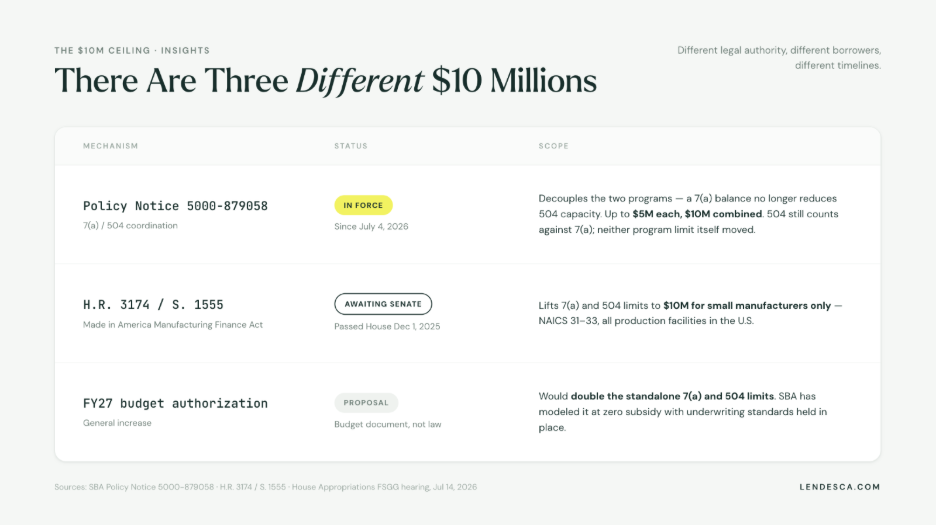
So, the borrower you can serve at $10 million today may not be a manufacturer; the manufacturer you might serve next year depends on the Senate; and the general increase everyone is excited about is a budget document rather than a law. These are worth knowing before the marketing goes out.
Why the increase should pass
The argument for raising the ceiling doesn’t need much math, but it does need the right math.
The $5 million limit was set in September 2010 and has not moved since. Run it through CPI and $5 million in 2010 dollars is roughly $7.7 million today, which means the ceiling has quietly surrendered about a third of its purchasing power while the industry treated it as a fixed feature of the landscape. Come at it from the other side, and the point sharpens: a $10 million ceiling is about $6.5 million in 2010 dollars. Doubling the number on paper delivers roughly a 31 percent increase in what a borrower can actually do with it. (CPI-U, June 2026) That is a correction, not an expansion.
Meanwhile, the deals themselves got larger for reasons having nothing to do with lender appetite. Loeffler told appropriators that manufacturing is now the agency’s largest lending category, and manufacturing transactions are the least likely of any category to fit under $5 million, because they often stack real estate, equipment, and working capital into one request.
The deals that do not fit, do not evaporate. I’ve watched them get carved into two facilities with a collateral position nobody is comfortable with. I have watched them go conventional at a shorter amortization with a balloon the borrower will have to refinance under whatever conditions happen to exist in five years, and I’ve watched them go to private credit in the low teens. The borrower still borrows. The financing simply gets worse, and the hiring attached to it gets smaller and later.
The standing objection to a higher ceiling is cost to the taxpayer, but that has been answered. SBA modeled the increase at zero subsidy, and CBO reached the same conclusion independently on both bills, estimating any change in guaranty costs as insignificant.
So, raise it. The program exists to serve the gap where conventional credit isn’t available at such terms, and that gap has been moving up-market for sixteen years while the loan ceiling stood still.
Now the harder part…
The line in the bill nobody quoted
Here is the provision that should have led every story about this bill.
Under 15 U.S.C. 636(a)(3)(A) — the clause the 2010 act wrote — SBA’s guaranteed exposure to any single borrower is capped at $3,750,000. That figure, not the loan limit, governs how much risk the agency actually carries. The House-passed text of H.R. 3174 does not replace it. It keeps $3,750,000 in place for every other borrower and adds a second clause: $7,500,000 where the borrower is a small manufacturer, against a $10,000,000 gross loan. The bill makes the parallel change on the international trade track, where the guaranty runs as high as 90 percent rather than 75. This lifts that cap from $4,500,000 to $9,000,000, of which no more than $8,000,000 may go to working capital and export financing.
Congress is moving the guaranty ceiling in step with the loan ceiling, which preserves the 75 percent structure at the larger size. That is genuinely good drafting. It is also the moment a bank should stop celebrating and open a spreadsheet, because the retained side of the trade moves too.

A bigger guaranty does not mean the agency absorbs more of your risk. It means you are holding twice as much of it per deal.
What twice the exposure does to a community bank
For a $20 billion institution, this is a rounding adjustment. For community and regional banks, it reorders several things at once.
- Your legal lending limit. For national banks, 12 CFR 32.3 excludes the portion carrying an unconditional federal guaranty, so the retained piece is what counts against the limit. State charters should check their own statutes. At $60 million of capital, $1.25 million of retained exposure is a Tuesday, but $2.5 million is a board conversation, and that shift happens without anyone deciding to change risk appetite.
- Your capital. The guaranteed portion generally draws a zero percent risk weight as a U.S. government exposure while the retained portion draws 100 percent for a standard commercial credit. Capital consumed per closing doubles right alongside the retained balance.
- Your concentration profile. Twenty $5 million loans and ten $10 million loans produce the same volume and very different portfolios. Examiners are already paying close attention to SBA and CRE concentration. Fewer, chunkier credits will not reduce that attention.
- Your secondary market economics. Bigger guaranteed portions mean bigger premiums per sale, which everyone has modeled, and bigger positions moving into 7(a) pools, which fewer people have. Pool investors will decide whether $10 million paper prices like $2 million paper – already dinged versus smaller loans with the same terms and interest spread — and their answer will show up in your gain-on-sale before you have a vote.
The deal will look familiar. It won’t behave that way.
Picture the credit. A metal fabricator with commercial property, equipment and forty employees is buying out a retiring competitor two counties over. The business acquisition includes a building in need of renovations, new equipment, and some working capital. Under current rules that transaction may get carved up or turned away. At a $10 million loan cap, it fits in one structure.
Then the file starts asking for things:
- Business valuation. At this size, an independent valuation is triggered on essentially every change-of-ownership transaction, and the scope grows with the complexity of the earnings story you are underwriting.
- Appraisal. More collateral usually means more reports, and each one has to be ordered correctly the first time. Under the agencies’ Title XI appraisal rules the lender or its agent — never the borrower — must engage the appraiser. A properly ordered appraisal can move between institutions with documentation. One the borrower ordered cannot be used at all, and having the appraiser readdress it to the bank does not cure the defect.
- Environmental. A fabrication facility is not a strip retail center. More of these transactions move from a records review into Phase I, and a real subset into Phase II, each with its own timeline.
- Construction and disbursement. The moment there is renovation in the deal you need inspection-based disbursement, lien waiver tracking, and retainage administration — an entire discipline that many SBA shops have simply never had to run.
- Affiliation and eligibility. Two operating companies, a holding structure, and a retiring owner with other interests. Size determination gets genuinely complicated, and it gets difficult at the front of the deal where nobody has time.
None of this is exotic. It is the same work, performed at the scale where doing it informally stops being survivable.
A missing certificate used to be an awkward phone call
Guaranty purchase review examines the file. When SBA processes a purchase request, the only question is whether the lender documented compliance with program requirements and prudent servicing, and the answer comes from the record rather than from anyone’s recollection of good intentions.
That review does not care how large the loan is, which is exactly why the size matters so much. A lapsed hazard insurance policy, an unperfected lien, an expired UCC continuation, three years of uncollected financial statements, undocumented care and preservation expenses — the odds of any one of them occurring are identical at every loan size. The bill is not.
On a $500,000 loan, a documentation defect is an embarrassing call with your SBA rep. On a $10 million loan with a $7.5 million guaranty, it is a line item your board will ask about by name.
Congress already put the audit on the calendar
This is the part of the story that has gone almost entirely unremarked, and it is the reason I would not touch these loans casually.
Section 5 of S. 1555 directs the SBA Inspector General, within two years of enactment, to analyze the cohort of loans made under the increased limits during the first year following enactment — specifically including whether the increases introduce additional risk such as increased default amounts, larger guaranty purchase amounts, or other pressure on the requirement that these programs operate at no cost to the government.
Read that twice. The first year of $10 million originations is a defined cohort. A federal Inspector General has a statutory mandate and a two-year clock to examine it, holding performance data that did not exist when the loans were written. Every lender active in that window will have its files read backward, by someone who already knows how the loans turned out.
Two banks can write identical loan volume in that window. The one that treated it as a land grab and the one that treated it as an audit-exposed cohort will not get identical results. The difference will not be credit judgment. It will be documentation.
Build the file like someone will read it in 2031
Because someone will. Origination systems built around half-million-dollar loans tend to treat documentation as accumulation — a folder that grows until closing. With an IG review scheduled, the file has to work as evidence instead.
- Requirements as tracked items, not checklists. Every SOP 50 10 8 requirement that applies to a given structure should exist as a discrete item with a defined satisfaction condition. The file advances when items close, not when a processor believes it looks complete, and every exception carries a name attached to the approval.
- Data fields, not buried PDFs. An insurance expiration date, a collateral schedule, a covenant threshold — these belong in structured fields. Liquidation happens years later, usually with different people in the chairs, and structured data survives that handoff in a way that a document folder does not.
- An audit trail you did not have to assemble. Purchase review asks who did what and when. A system that stamps action, actor, and timestamp answers immediately. A system that requires reconstructing the answer from old email threads answers slowly, partially, and expensively.
- Reporting that reconciles itself. 1502 reporting drives guaranty status, and manual monthly reconciliation is how guaranty status quietly becomes wrong. Make it systematic and exception-reported.
The guaranty erodes quietly
Nobody loses a guaranty in a dramatic moment. It happens across four years of small omissions that each looked minor at the time, which is why servicing infrastructure matters more at $10 million than any underwriting refinement.
- Post-close obligations with teeth. Insurance renewals, UCC continuations, annual financial statements, tax verification, required site visits — each is a servicing requirement with a repair consequence attached. Each should be a dated obligation with escalation, and the escalation has to reach somebody who can actually act on it.
- Early warning that arrives early. Payment behavior, deposit activity where you hold the operating relationship, covenant performance. At $10 million, catching deterioration in month three instead of month nine is the difference between a workout and a liquidation, and the gap between those two outcomes is most of your retained exposure.
- Continuity through the handoffs. Loan knowledge degrades every time a credit changes hands between origination, closing, and servicing. Keeping one organization — and where possible, the same people — across the life of the loan preserves the context that makes early intervention possible at all.
- Liquidation readiness before default. Care and preservation expenses are recoverable when documented and gone when they are not. Liquidation plans, updated appraisals, and expense records belong in ordinary servicing rhythm rather than assembled in a panic after the loan has already stopped paying.
The first cohort decides the next increase
I want this to pass. That is exactly why I am writing about repair exposure and Inspector General cohorts instead of celebrating a headline number.
Everything moving through Congress and the administration’s budget expands what banks are allowed to do. None of it expands what any particular bank is prepared to do, and the space between those two things is where the next several years of program performance will be settled. In 2010 the industry got a larger ceiling and worked out the implications on the way down. This time the arithmetic is published, the guaranty math sits in the bill text, and the Inspector General already has the assignment.
The fastest way to lose a higher ceiling is to earn a bad first cohort with it. Every lender that writes a clean $10 million file is building the case for the next increase. Every lender that does not is helping draft the report that takes this one away. Let’s be responsible as an industry.

If you’re evaluating a deal in the $5–10 million range, the right first step is a conversation about structure before the LOI terms are set.
At Lendesca, we built our platform specifically for banks that want access to the 7(a) market’s risk-adjusted returns without the cost and complexity of standing up an internal SBA department. The data above is the case for why that matters. If you’re a bank executive evaluating your SBA strategy, we’d welcome the conversation.
SOURCES
— Small Business Jobs Act of 2010 (P.L. 111–240), § 1111
— 15 U.S.C. § 636 — Small Business Act § 7(a)
— SBA Policy Notice 5000-879058, Coordination of 7(a) and 504 for Maximum Loan Limits
— SBA, Small Businesses Now Eligible for $10 Million in SBA Financing (July 7, 2026)
— H.R. 3174, Made in America Manufacturing Finance Act — bill status
— H.R. 3174 — House-passed text
— S. 1555, Made in America Manufacturing Finance Act of 2025 — text, incl. § 5 Inspector General analysis
— CBO cost estimate, H.R. 3174
— CBO cost estimate, S. 1555
— House Appropriations FSGG Subcommittee, SBA oversight hearing (July 14, 2026)
— 12 CFR 32.3 — Lending limits
— BLS Consumer Price Index news release (CPI-U, June 2026)
— SBA SOP 50 10, Lender and Development Company Loan Programs