A recent episode of The Deep Dive podcast examined our pitch materials and financial overview — and the conversation that followed is one of the clearest explanations we’ve heard of why SBA lending is broken and what it takes to fix it.
Rather than summarize our own model in our own words, we thought we’d let the analysis speak for itself. The hosts asked sharp questions, challenged the claims, and arrived at their own conclusions.
Here are the key takeaways.
The Paradox That Defines the Industry
The podcast opens with what the hosts call “an economic paradox that once you see it, you can’t unsee it.”
Three players are in a room: a small business owner who needs capital, a bank that exists to lend money, and the federal government offering to guarantee up to 75% of the loan. On paper, the money should flow freely. In reality, it barely moves.
As one host put it: the number of active SBA lenders is actually shrinking — even as borrower demand remains strong. The top 5% of SBA lenders now originate over 70% of total volume, and the top 20% account for more than 92%.
Their conclusion? This isn’t a demand problem. It’s a supply problem disguised as a demand problem. Community banks want the yield. Borrowers want the capital. But the operational machinery required to connect them is too expensive and too complex for most institutions to build internally.
Why Banks Walk Away From a “Gold Mine”
The analysts were struck by the economics of SBA lending. They described the asset class as “incredibly high performing” and noted that the recent charge-off rate for SBA 7(a) loans was just 0.436% — a figure one host called “effectively zero in the commercial lending world.”
On the return side, they walked through the math on a typical $1 million SBA deal: between interest spread, servicing fees, and secondary market premiums, total return on investment approaches 160% over a five-year hold.
One host’s reaction captured the disconnect perfectly: this combination of government-backed safety and strong returns should make SBA loans irresistible. So why are community banks walking away?
The answer, as the podcast details, is the SBA’s Standard Operating Procedures — thousands of pages of federal regulations that change constantly. A single missed signature or undocumented environmental check can void the government guarantee entirely. Banks need specialized staff who, as the hosts noted, “are expensive, actively aging out of the workforce, and incredibly hard to find.”
The estimated cost to build an internal SBA department? Four to eight million dollars — for a community bank that might see three or four viable deals per year.
“Death by a Thousand Emails”
The hosts spent considerable time on the traditional SBA lending process, which they described with words like “grim” and “painful.”
The typical timeline: 60 to 90 days from application to funding. But the delay isn’t usually the government — once a finalized package reaches the SBA, they respond relatively quickly. The real bottleneck is legacy processing inside the bank itself.
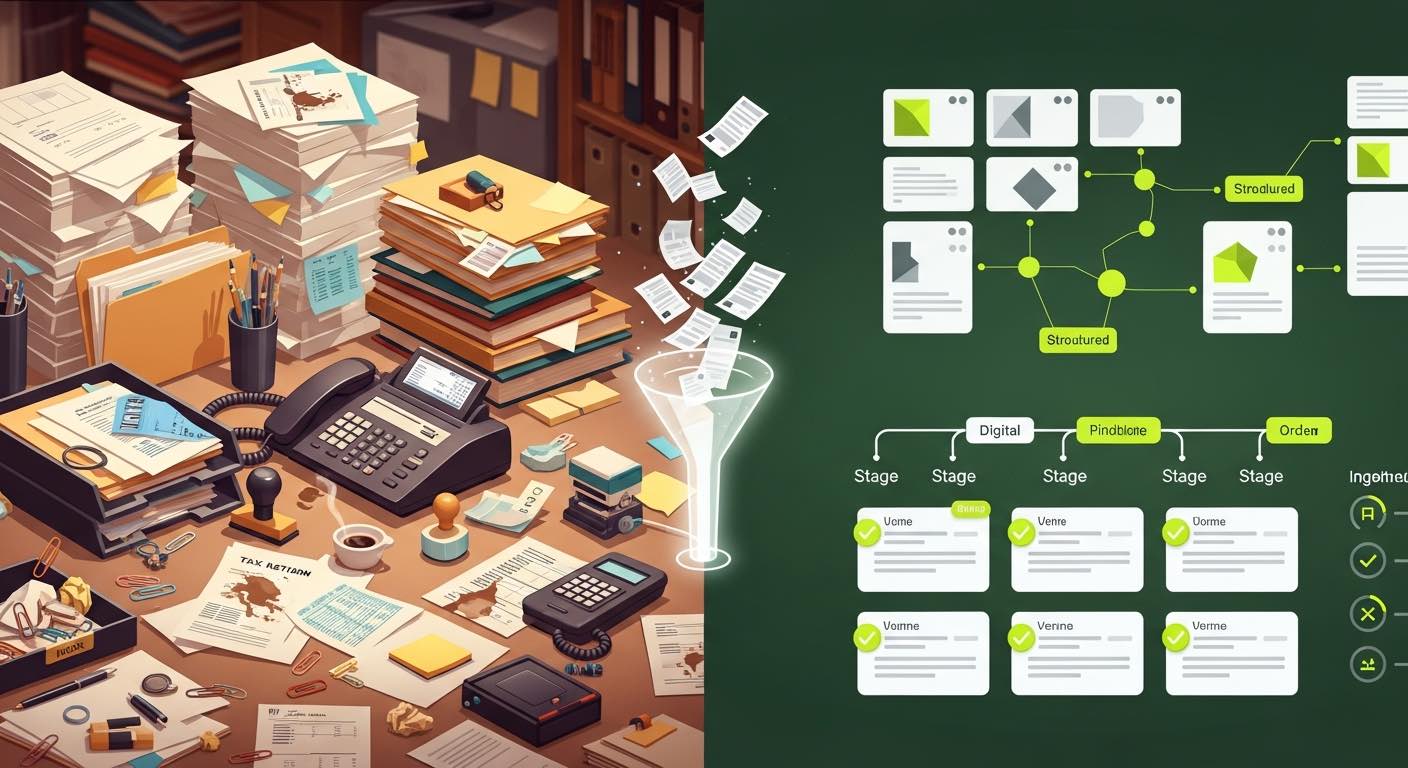
The intake phase alone — simply gathering documents from the borrower — takes two to three weeks in the traditional model. Then a highly paid underwriter manually enters data from printed documents into spreadsheets to calculate cash flow. One host captured the absurdity well: we have self-driving cars on the road, but banking is still manually typing tax return data into Excel.
The industry’s previous solution? What the analysts called “the labor arbitrage trap” — outsourcing data entry to lower-cost regions. Their assessment of that approach was blunt: it didn’t make things faster, it just made slowness cheaper.
From “Artisanal Lending” to “Origination on Demand”
This is where the conversation shifted to Lendesca’s model. The hosts drew a distinction between standard AI chatbots — which are reactive, answering questions when asked — and agentic AI, which is proactive and goal-oriented. You give it a mission (“process this loan application”), and it autonomously figures out the steps, executes them, checks its own work, and moves forward.
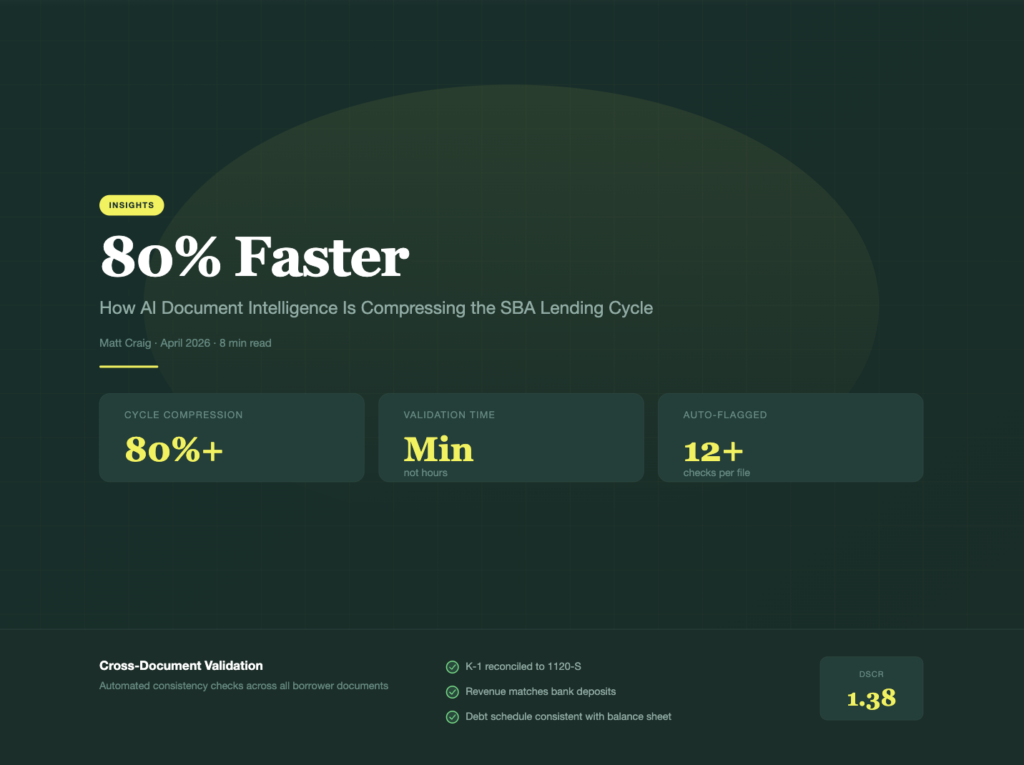
Applied to SBA lending, the analysts walked through how the system handles document intake: borrower uploads are actively read using AI that understands financial context — not just recognizing shapes and letters, but understanding what a 1040 looks like versus a K-1, cross-referencing figures in real time, and flagging discrepancies immediately rather than weeks later.
Their assessment of the impact: intake and validation compressed from three weeks to approximately one hour. Credit memo drafting — a process that normally takes days of focused underwriter time — completed in roughly two hours. Total cycle time from application to funding: 15 to 20 days.
“It’s Not About Replacing the Banker”
The hosts pressed hard on the question of AI judgment in high-stakes lending decisions — and noted that this is where the positioning is deliberately careful.
The architecture they described is “human in the loop”: AI handles the heavy lifting (document gathering, data extraction, math, initial drafting), while veteran human underwriters focus entirely on credit analysis and the final decision. As one analyst framed it, the AI is “the world’s most efficient junior analyst,” while the human expert’s judgment remains the deciding factor.
The analogy that resonated most: it’s not about replacing the banker. It’s about giving the banker an Iron Man suit. You keep the human judgment but lose all the friction. The result, according to the analysis, is that a single underwriter can handle eight to ten times their normal volume.
The Bank’s Perspective: “The Driver and the Engine”
One section of the podcast focused on the business model — specifically, the originating LSP structure that allows banks to participate without building infrastructure.
The hosts used a car analogy: the bank is the driver (setting credit policy, determining risk appetite, making the final yes-or-no decision), while Lendesca is the engine (sourcing borrowers, processing data, structuring deals, delivering finished packages). The bank presses the gas pedal — Lendesca does everything under the hood.
What caught the analysts’ attention was the cost structure. They contrasted the estimated four to eight million dollar price tag for building an internal SBA department against an initial investment with the LSP model of zero fixed cost. The bank pays variable fees only on loans they actually fund.
As one host summarized: it converts a massive, terrifying fixed cost into a variable cost. You only pay if you make money.
What It Means for Main Street
The podcast closed with a broader reflection on what happens if this model scales. The hosts noted that if a community bank in rural Ohio can plug into the same processing infrastructure as the largest banks on Wall Street, the competitive advantage shifts from who has the biggest back office to who has the best cost of capital.
Their final assessment was direct: this is “a massive plumbing fix for a multi-billion dollar sector of the economy.” If it works, the impact extends beyond bank balance sheets to every main street in the country — effectively unlocking capital that the government has been trying to deploy for decades.