Let me describe a scene that anyone in SBA lending will recognize immediately.
A borrower submits a loan application with 150 pages of documents — tax returns, financial statements, a purchase agreement, personal financial disclosures. Those documents land on an underwriter’s desk. The underwriter opens the first tax return, starts reading page by page, and begins manually entering numbers into a spreadsheet. Hours later, they move on to the bank statements. Then they notice the K-1 on the personal return doesn’t match the corresponding line on the business return. They send an email to the borrower asking for clarification. Three days pass before the borrower responds. The underwriter picks the file back up, re-orients themselves, and continues.
Multiply that by every document, every discrepancy, and every borrower in the pipeline. Repeat for 60 to 90 days. That’s the traditional SBA lending cycle.
Now let me describe what happens at Lendesca.
The same 150 pages are uploaded to our platform. Within minutes — not hours, not days — our AI document intelligence has read every page, extracted the relevant financial data, cross-referenced figures across documents, flagged inconsistencies, and populated the underwriting workbench with organized, validated information. The underwriter opens a file that’s already been structured, reconciled, and prepared for credit analysis.
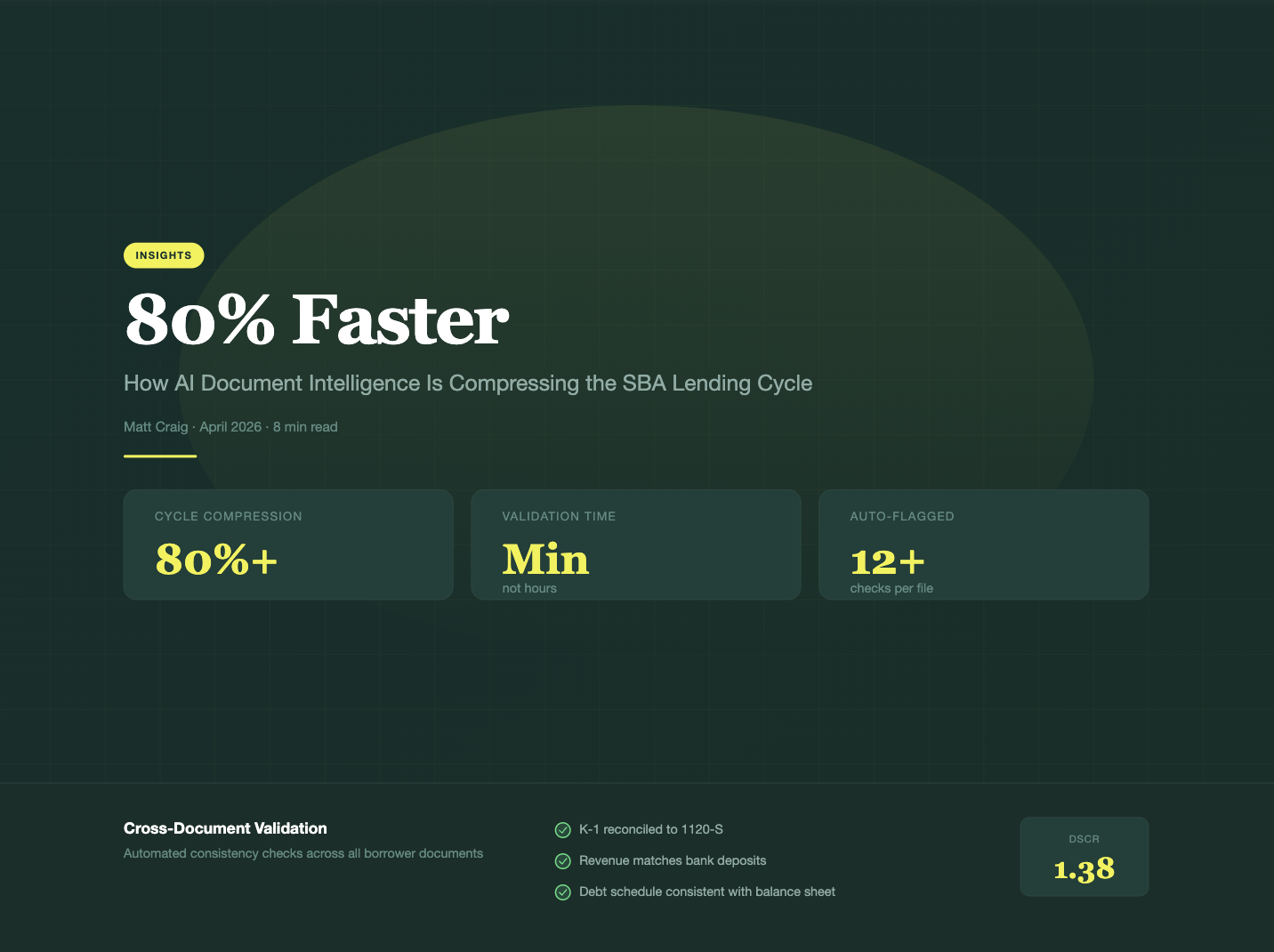
That’s not a vision for the future. That’s what we’re doing today. And it’s compressing the SBA lending cycle by more than 80%.
The Bottleneck Was Never the Credit Decision
Here’s something that surprises people outside the industry: the actual credit decision on most SBA loans is relatively straightforward. An experienced underwriter can evaluate a deal’s viability in a matter of hours once they have clean, organized financial data in front of them.
The bottleneck has always been everything that happens before the credit decision — the document collection, the data extraction, the validation, the back-and-forth with borrowers over missing or inconsistent information. In a traditional SBA workflow, this pre-decisioning phase consumes 60% to 70% of the total processing time.
This is precisely the phase where AI delivers transformational value. Not by replacing human judgment on credit decisions, but by eliminating the manual labor that buries that judgment under weeks of administrative work.
What AI Document Intelligence Actually Does
When we talk about AI in lending, it’s important to be specific — because the term gets thrown around loosely in this industry. “AI-powered” on a marketing page doesn’t mean much. Here’s what it means in practice at Lendesca.
Intelligent document classification. When a borrower uploads a stack of documents, our system automatically identifies what each document is — personal tax return, business tax return, bank statement, P&L, balance sheet, lease agreement — and routes it to the appropriate processing pipeline. No manual sorting. No mislabeled files sitting in the wrong folder for a week.
Optical character recognition with contextual understanding. Our AI doesn’t just read text on a page — it understands the structure and context of financial documents. It knows where to find adjusted gross income on a 1040, how to extract EBITDA from a P&L, and how to identify the relevant line items across different formats and accounting software outputs. This is a fundamentally different capability than basic OCR, which just converts images to text without understanding what the text means.
Cross-document validation. This is where the real time savings happen. Our system automatically cross-references data across documents — does the revenue on the P&L match the deposits in the bank statements? Does the K-1 on the personal return reconcile with the business return? Are the debt payments on the debt schedule consistent with what appears on the balance sheet? In a manual process, these reconciliations take hours per file. Our system does them in minutes and flags discrepancies for human review rather than requiring the underwriter to hunt for them.
Automated gap identification. Before an underwriter even opens the file, the system has already identified what’s missing. If the borrower uploaded two years of tax returns but the application requires three, it’s flagged. If the bank statements cover January and February but not March, it’s flagged. If a required form is missing entirely, the borrower is notified through the portal immediately — not two weeks later via email.

The Impact on the Lending Cycle
When you compress the pre-decisioning phase by 80%, the downstream effects ripple through the entire process.
Underwriters focus on analysis, not administration. Our underwriters spend their time on what they’re actually trained to do — evaluating credit quality, assessing risk, structuring deals. They’re not spending hours on data entry, document sorting, or chasing borrowers for missing paperwork. This doesn’t just make the process faster — it makes the credit analysis better.
Borrowers get answers sooner. The most common complaint from SBA borrowers isn’t about rates or terms — it’s about the black hole. They submit their application and hear nothing for weeks. In our model, borrowers have real-time visibility into their application through our portal, and the compressed timeline means they move from application to decision in a fraction of the traditional timeframe.
Bank partners process more volume. For the community banks we serve as an LSP, the throughput improvement is a game-changer. A bank that previously had capacity for 5 to 10 SBA loans per month can now handle multiples of that volume without adding headcount — because the technology is handling the work that used to require bodies.
Default rates stay low. Speed doesn’t mean cutting corners. Because our AI is doing more thorough document validation than most manual processes — catching inconsistencies that a human reviewer might miss under time pressure — the quality of our credit analysis actually improves as volume scales. Our approximately 2.6% default rate, compared to an industry average near 7.9%, reflects this: we’re faster and more rigorous.
What This Means for the SBA Ecosystem
The implications extend beyond any single lender or LSP.
The SBA 7(a) program exists to get capital to small businesses that can’t access conventional financing on reasonable terms. Every day that a loan application sits in a processing queue is a day that a business owner isn’t hiring, isn’t expanding, isn’t buying the equipment they need to grow. The inefficiency of the traditional process doesn’t just frustrate borrowers — it has a real economic cost.
AI document intelligence doesn’t change the SBA’s rules or lower the bar for credit quality. What it does is remove the friction that has historically made those rules expensive and slow to administer. More loans can be processed by fewer people in less time, at higher quality. That’s not a trade-off — it’s a genuine efficiency gain.
For community banks, this means SBA lending is viable again as a business line — not just in theory, but in practice. The operational cost that previously made SBA uneconomical for smaller institutions has been dramatically reduced.
For borrowers, it means the SBA loan experience is finally starting to match the speed and transparency they’ve come to expect from every other financial interaction in their lives.
And for the industry, it means we’re entering a period where the lenders with the best technology — not just the biggest sales teams or the lowest rates — will be the ones that win.
Looking Ahead
We’re still in the early innings of what AI can do in government-guaranteed lending. The document intelligence capabilities we’ve deployed today will continue to improve as the models get smarter and the data sets get larger. We’re actively building toward a future where the system can not only process and validate documents, but proactively identify structuring opportunities, flag potential compliance issues before they arise, and guide borrowers through the application process with increasingly personalized support.
But I want to be clear about something: the goal is not to remove humans from the lending process. The goal is to make human expertise more valuable by removing the parts of the process that never needed a human in the first place. The best underwriters in SBA lending — the ones with decades of experience and deep credit judgment — shouldn’t be spending their days typing numbers from tax returns into spreadsheets. They should be evaluating deals. Our technology makes that possible.
The SBA lending process was broken for a long time. Not because the program was flawed, but because the tools and infrastructure available to lenders hadn’t kept pace with the complexity of what they were being asked to do. That’s changed.
We fixed it.